
Climbing the Inner Mountain with a Wild Walk Through Maslows Hierarchy of Needs
Nov 29, 2025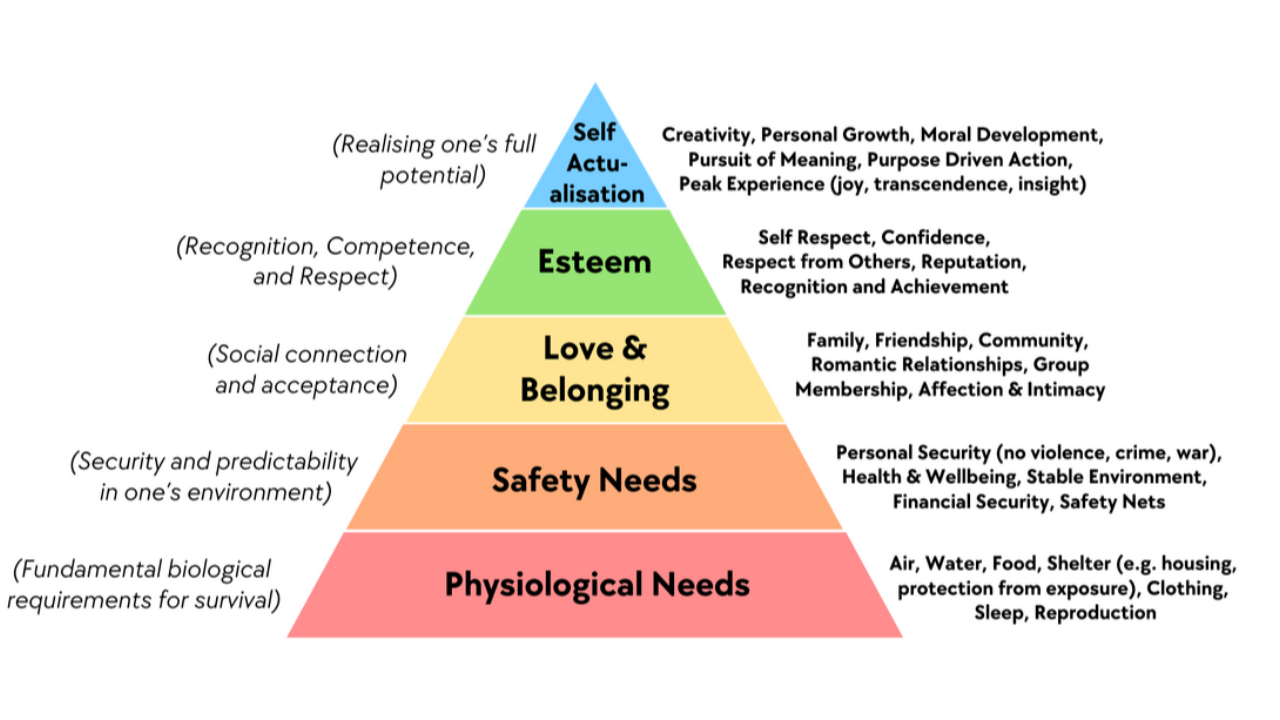
“If you plan on being anything less than you are capable of being,
you will probably be unhappy all the days of your life.”
Abraham Maslow
There is a longing many of us carry quietly inside — a whisper that says:
“I want to feel safe. I want to feel seen.
I want to be more than just surviving. I want to become who I really am.”
This longing isn’t foolish or far-fetched, and it’s certainly not too much. It is the deepest rhythm of being human.
We are wired not just to exist — but to evolve.
That evolution follows a wild and wise pathway first mapped by psychologist Abraham Maslow, who believed every human is capable of extraordinary things when their core needs are honoured. He named this inner climb the Hierarchy of Needs — a five-layer pyramid showing how human motivation rises from survival to transcendence.
This Heirachy of needs is more than just psychology.
It’s a soul map.
A call to come home to yourself, one brave step at a time.
And in this Wild Wellness with Hannah exploration of Maslow’s Hierarchy of Needs, we’re not just studying it — we’re living it.
A musician must make music,
an artist must paint, a poet must write
if they are ultimately to be at peace with themselves.
Abraham Maslow
Have you ever felt that quiet tug inside — the one that begs for a nourishing meal, a safe place to rest, and a bigger, bolder reason to wake up? That pull isn’t chaos; it’s the elegant order of needs Maslow first shared in the 1940s and later refined in 1954.
Maslow imagined our needs stacked like a pyramid:
first we anchor into survival,
then step into safety,
weave ourselves into belonging,
rise into esteem,
and finally unfold into self-actualisation — our fullest, truest expression.
Today, we are hiking that pyramid together by turning timeless theory into lived, embodied, soul-powered practice.
You might be wondering who Abraham Maslow is.
Abraham Maslow was an American psychologist born in 1908. Known for his Humanistic Psychology, he focused not on dysfunction, but on potential. While others studied what made people broken, Maslow asked, What makes people thrive?
He believed that beneath our pain, confusion, and defense mechanisms was a glowing center—our true self, waiting to unfold like a flower. His Hierarchy of Needs (published in 1954) became a framework not only for therapists and educators—but for anyone seeking growth, purpose and peace.
Maslow’s model breaks our needs into five levels—starting from basic survival and building toward self-actualisation. Each level feeds the next. When one is unmet, our focus shifts there. When met, we gain energy and clarity to ascend.
Let’s explore them one by one—practically, poetically and personally.
1. Physiological Needs
Food • Water • Breath (Air) • Rest • Warmth • Touch • Reproduction
These are our earth-roots. Without them, nothing else grows.
This is where it all begins. The non-negotiables f your body. No matter how spiritual or motivated you are, if you are dehydrated, starving or sleepless, your nervous system can’t rest—and your soul can’t rise.
We are not bobble heads bouncing away.
We are wild, wonderful bodies that deserve care, nourishment and rhythm.
Ways to meet this need;
Eat meals slowly, chewing with reverence.
Drink herbal teas or room-temp water before coffee.
Rest—not as a luxury, but as a sacred requirement.
Practice conscious breathing. Even three breaths can re-anchor your system.
Mastery Practices
Sacred hydration: Begin each morning with a glass of room-temperature water and a whispered intention.
Rhythmic rest: Guard sleep like a rare gem—create a dusk ritual (dim lights, soft music, lavender oil) that says, “Body, it’s time to heal.”
Pleasure-plate: Colour half your plate with plants; chew slowly; thank every bite for becoming you.
Wild Reminder: Honouring your body is spiritual. Start here. Always.
2. Safety Needs
Shelter • Stability • Financial security • Health • Predictability • Boundaries
Safety is the gentle fence that lets your nervous system exhale.
Once survival is steady, the body seeks safety: “Am I secure here?” This includes the external world (having a roof, steady income, safe relationships) and the internal world (nervous system regulation, routines, predictability).
Without this sense of safety, we live on high alert. Life becomes reactionary. We can’t access our highest ideas or deepest truths because the brain is too busy scanning for threats.
Ways to meet this need;
Establish grounding rituals—wake, walk, write, rest.
Budget with curiosity, not shame.
Reassure your inner child: “We’re okay now.”
Set small boundaries with kindness and clarity.
Mastery Practices
Nervous-System Nest: Keep one physical nook (a reading chair, a meditation mat) where nothing chaotic happens. Visit daily.
Empowered Finances: Track spending for 30 days with curiosity, not judgement—each dollar becomes data, each choice a vote for future you.
Boundary Ritual: Write three non-negotiables that protect your energy, and practice stating them—in the mirror, then in real life.
Wild Reminder: Safety is not just about walls and locks. It’s about feeling safe inside your own skin.
3. Love & Belonging Needs
Friendship • Family • Intimacy • Connection • Community
We are pack animals with tender hearts.
We are social beings. We heal in connection and yet so many of us carry wounds around rejection, abandonment or not-belonging.
This level is about both giving and receiving love. Feeling seen. Heard. Valued.
It’s also about belonging to yourself—being your own home before asking anyone else to be it.
Ways to meet this need;
Call someone you miss. Leave a voice note of love.
Say “I feel…” more often. Let people into your truth.
Dance or write to reconnect with your inner world.
Join or create a community—online or in-person—where your soul can speak freely.
Mastery Practices
Intentional Reach-Out: Send one genuine voice memo a day (“Thinking of you because…”) to weave invisible threads of care.
Courageous Vulnerability: Share a recent struggle with someone safe; notice the warmth that flows back.
Circle of Resonance: Join (or host) a monthly gathering—book club, breathwork circle, ocean swim—where authenticity is the dress code.
Wild Reminder: You were never meant to do life alone. Connection is not a weakness. It is your nature.
4. Esteem Needs
Self-respect • Achievement • Capability • Recognition • Mastery
Here, we claim our gifts and offer them to the world.
This is the place where we want to matter.
To feel like our efforts are seen.
To stand in our power with confidence.
It’s where you say: “I have value. I trust myself. I respect who I am becoming.”
There’s a healthy version of esteem—rooted in inner truth and effort—and a distorted one, based on comparison and external validation. Our job? To center our self-worth in what we honour within, not what others decide we’re worth.
Ways to meet this need
Keep promises to yourself (even small ones).
Celebrate progress, not perfection.
Create something: art, words, space, love.
Say no with grace and yes with enthusiasm.
Mastery Practices
Wins Jar: Drop written notes of every tiny victory into a jar; read them on low-esteem days.
Skill-Sprint: Commit to 15 minutes a day on a craft that lights you up—ukulele strums, Spanish verbs, coding basics, cartwheels.
Mirror Mantra: Stand tall, look yourself in the eye, and say, “I honour the wild magic I bring.” Mean it a little more each day.
Wild Reminder: Confidence grows from courageous action, not external applause.
5. Self-Actualisation
Creativity • Authenticity • Purpose • Potential
This is where the soul stretches out its arms and says: “This is me. And I’m here for something beautiful.”Self-actualisation isn’t a destination—it’s a way of being. It’s the alignment between your real self and your ideal self. It’s living in integrity with your values. It’s flow, presence, and deep inner fulfillment.
Maslow noted that people at this level often live unconventional lives. They’re guided by intuition, creativity, and service—not social norms.
🌸 Ways to Meet This Need
Prioritise creative expression over consumption.
Follow your curiosity until it leads you somewhere sacred.
Guide, teach, mentor or uplift others in ways only you can.
Carve out time for solitude, spiritual practice, or reflection.
Wild Reminder: This is not about being better. It’s about being true.
Met needs feel like steadiness—body relaxed, breath easy, decisions clicked into place.
Unmet needs whisper first (tiredness, restlessness), then shout (anxiety, burnout).
Track them gently. No shame. Needs unmet are simply invitations to recalibrate.
Your needs are not linear.
You may feel safe today, lonely tomorrow and creatively inspired the next.
That’s okay as it is all part of the human experience.
Maslow never said we have to “complete” a level to move on.
We revisit layers throughout life, healing deeper each time.
What matters is awareness. When you’re off-center, ask:
Which of my needs feels unmet right now?
How can I tend to it with love and compassion, not judgment or shame?
The path from physiological survival to soulful self-expression isn’t paved.
It is often messy, winding and wildly human, with detours, setbacks, pauses and peaks, but every step is sacred. Every moment you feed your body, protect your peace, speak your truth or create from the heart, you are climbing Maslow’s inner mountain — not for status, but for soul alignment.
The view from the top is you.
It’s you — alive, radiant, whole.
Not perfect.
But real.
Why We All Can Reach the Summit
Maslow believed every human is wired for growth.
This pyramid isn’t reserved for sages or spiritual elites — it’s an open trail, available to anyone willing to take the next small step. Sometimes we leap forward, sometimes we slide back, and other times we crumble in a heap.
Life events can shake our foundations, pulling us down to earlier layers. Each return isn’t a failure — it’s an invitation to rebuild with deeper wisdom, stronger roots, and clearer awareness.
Authentic happiness lives in the space where the ideal self (our dreams) meets the real self (our present truth). When these parts align, our lives become unconventional, unapologetic, and purpose-driven — shaped not by expectation, but by inner resonance.
As you climb your own inner mountain, reflection becomes both a compass and a companion. These questions are invitations — gentle doorways leading you deeper into self-understanding, self-compassion, and soulful clarity. Take them to your journal, your meditation cushion, your favourite café or a long ocean-side walk.
Be sure to remember that your needs are not weaknesses; they are navigational stars guiding you home to yourself.
Which layer of Maslow’s pyramid feels strong and nourished in my life right now? Which layer feels tender or hungry?
How does my body signal an unmet need before my mind catches on?
When a need isn’t met, do I avoid it, criticise myself or reach out for support?
What is one need I’ve been ignoring? How can I tend to it with care this week?
What tiny yet powerful action can I take to strengthen my sense of safety and grounding?
Where am I withholding my gifts out of fear of judgment?
What does self-actualisation mean to me — not as a concept, but as a lived experience?
When was the last time I touched self-actualisation? What was I doing, feeling, or creating?
What creative or purposeful act helps me feel aligned with my soul?
If I truly believed all my needs were valid and worthy of being met, how would tomorrow look different?
Let these reflections guide your steps. Trust their timing, trust their wisdom, and trust yourself as you climb.
Your needs are not too much.
Your longings are sacred.
Your growth is a spiral—not a straight line.
You, wild one, are worthy of climbing all the way to the top—again and again.
Let this be your invitation to listen more deeply… to what your body, heart, and soul are asking for because the pyramid isn’t just theory.
It’s the path home to your wild, wonderful self. 🌾
See you at the summit, wild one. 🌙✨
